How a Big Bang Woke Me Up and Might Wake You Up Too
By Beau Bristo
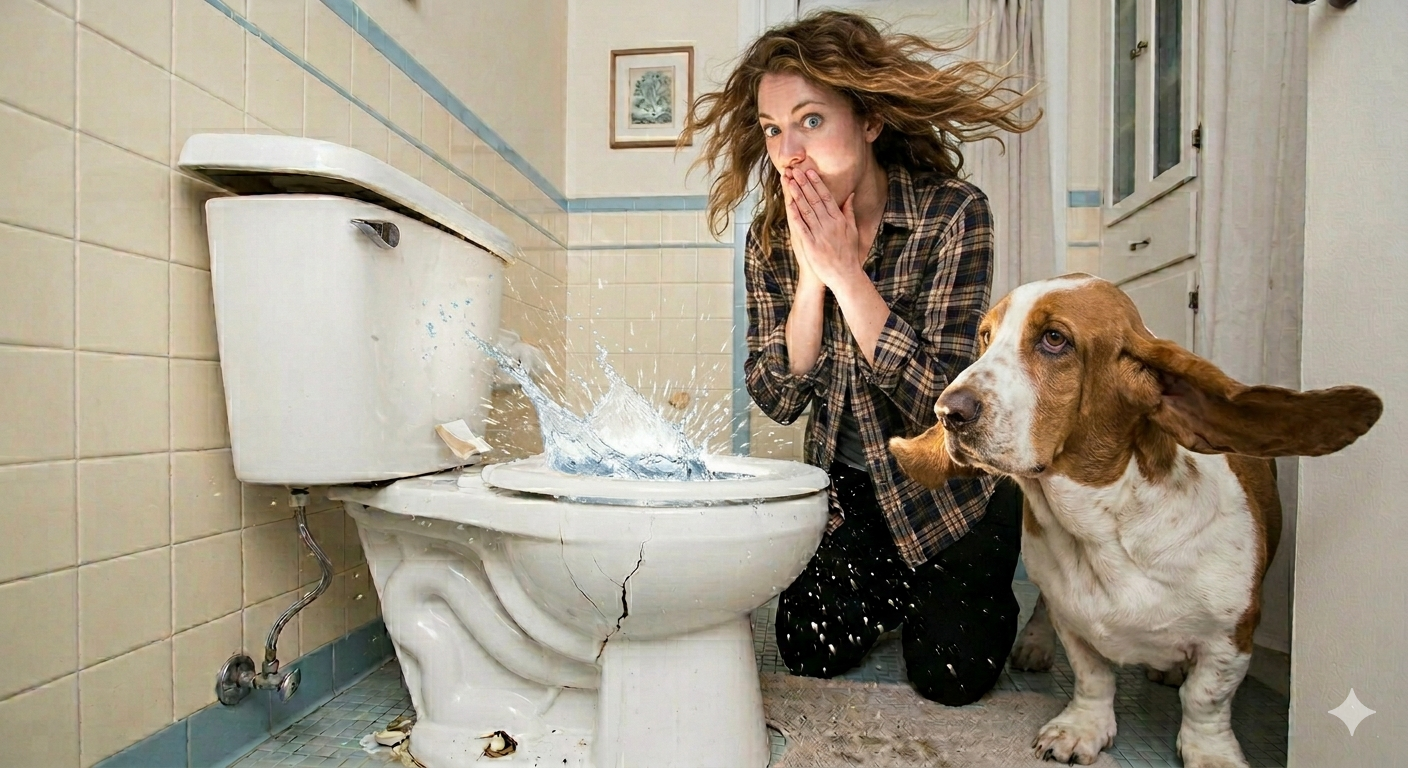
Giving New Meaning to The Big Bang Theory
Friday morning my kitchen faucet started making sounds. Sputtering pipes. Gaps in the water flow. Whooshing. Then I flushed a toilet and it banged — like a backfire, like something underneath the floor had given up.
My first move wasn't to call the utility company. My first move was to start checking my own lines. Crawling around looking for a leak. Wondering if my pressure valve had failed. Researching like it was on me to have caused this.
Turns out a utility crew was a few houses down, working on the main line. Nothing to do with me at all.
The Inspection Instinct
Here's what I actually want you to see. It’s not about plumbing. But instinct.
The instant something feels wrong, where does attention go first? For a lot of us, inward. We check our own “home” before we ever consider that the disruption came from outside.
We ask: What did I do to cause this?
Not: What was done near me, or to me, by something I never agreed to and couldn't see?
That's the architecture of a conscientious mind. It's also, often, exactly where someone who's caused harm to us wants our attention to go.
The Asymmetry
Here's the part that actually got under my skin as I was underneath my house with only a 40-watt bulb barely shedding enough light to see the pipe.
The utility company wasn’t going to lie awake that night wondering if they'd disrupted my street. They didn't audit their conscience. They worked the main line and moved on. No malice — just no occasion to reflect, because the disruption wasn't theirs to feel.
Meanwhile I'm down here on the dirt basement floor, questioning my own pressure valve.
That's the asymmetry. The people who externally cause a disturbance rarely interrogate their part in it, because they're not the ones living inside the damage. The people inside the damage are the ones doing all the agonizing self-examination.
Conscientiousness, misapplied, becomes a kind of tax only the innocent pay.
When There's No Diagnostic Manual for the Soul
With the pipes, eventually, I got information. A phone call. A clear answer: it wasn't me, it was several houses down.
The soul rarely gets that phone call.
When the disruption is relational — a misunderstanding, a betrayal, a sudden coldness from someone you trusted — there's no utility company to ring and confirm we were working on something near you today, that's the bang you heard. The source, if there is one, has often already left the scene. No confession. No diagnostic. Just the after-bang, and you, alone with a 40-watt bulb, checking your own foundation because it's the only one you can actually access.
So we infer. We fill the silence with self-blame, because self-blame is at least an answer, and an answer — even a wrong, painful one — feels more bearable than the open question of I don't know what happened or why.
Two Architectures
A house has documented architecture. Blueprints. Pressure ratings. Someone, somewhere, can point to a schematic and say here's where the line runs, here's what should be true.
The soul's architecture isn't drafted anywhere. No inspector signs off on it. So when something rattles it, we don't have a blueprint to check against — just the felt sense that something is off, and a long, lonely habit of assuming the offness started with us.
Maybe that's the real difference worth naming. Not that one structure is fragile and the other strong. But that one comes with documentation, and the other has to build its own — slowly, after the fact, often without anyone outside ever confirming what actually happened.
The Point
I'm not saying stop checking your own lines. Self-inspection, done right, is how we stay honest and grounded in the truth of what actually happened.
I'm saying notice when you've made it your only move. Notice if every disruption automatically gets routed inward, while the actual source — whoever or whatever it was — walks off without a second thought.
Sometimes the bang in the pipes isn't a failure in your house at all.
Sometimes it's just proof that something happened nearby, and you're the one who heard it loudest, because you're the one who lives there and the person who caused the backfire has no idea how much it affected you, or worse, they don’t care if they do know.
That’s when it’s time to reflect on patterns and why people who don’t care how they affect you are even in your life. When did that pattern start and why? These answers will lead you to your relationship blueprint and where things went askew.
Remember, you're not alone in this, and if you're ready to start rebuilding your life and relationship patterns, that's exactly the work we do at Soul Rebuild, www.soulrebuild.com. If you want access to your original blueprints - a detailed in-born temperament translation - head to thetemperamenttranslator.com. It gives you a shortcut to who you would have been before the bang even happened.